OpenClaw vs LangChain vs CrewAI vs AutoGPT
OpenClaw is a production-ready AI agent framework for building personal assistants. Here's how it compares to LangChain, CrewAI, and AutoGPT.
If you're building an AI agent in 2026, you have more framework options than ever. The challenge isn't finding one – it's picking the right one for what you're actually building. This comparison breaks down four popular open-source frameworks: OpenClaw, LangChain, CrewAI, and AutoGPT. Each solves a different problem.
Quick Comparison
| OpenClaw | LangChain | CrewAI | AutoGPT | |
|---|---|---|---|---|
| Focus | Personal AI agents | LLM orchestration | Multi-agent teams | Autonomous agents |
| Production-ready | Yes | Yes | Growing | Experimental |
| Persistent memory | Built-in | Manual setup (vector stores) | Limited (short-term) | Limited |
| Messaging channels | Telegram, WhatsApp, Discord, Slack | None built-in | None built-in | None built-in |
| Skill/plugin system | First-class skills with sandboxed execution | Tools (generic callable functions) | Tasks (role-based) | Commands |
| Self-hosted | Yes | Yes | Yes | Yes |
| Primary language | TypeScript | Python | Python | Python |
| Sandboxed code execution | Yes | No | No | Yes |
| Multi-model support | OpenRouter (100+ models) | Any LLM provider | Any LLM provider | OpenAI primarily |
| Learning curve | Moderate | Steep (large API surface) | Low–Moderate | Low |
OpenClaw: Build Personal AI Agents
OpenClaw is a TypeScript framework purpose-built for personal AI assistants. Its core assumption: your agent talks to a real person through a real messaging channel, remembers their context over time, and has skills it can invoke.
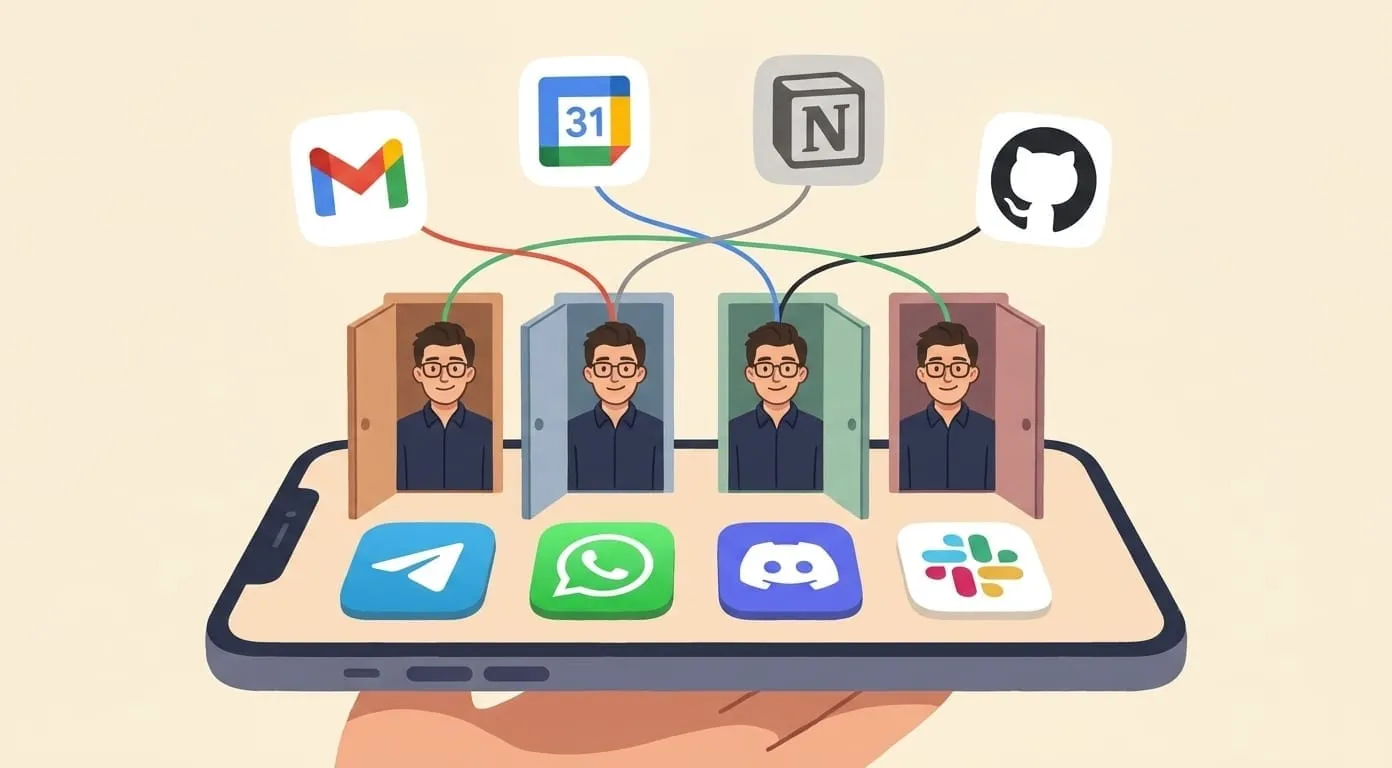
Architecture: Agent → Channels (Telegram, WhatsApp, Discord, Slack) → Skills (modular capabilities) → Memory (persistent, cross-channel). Each component is pluggable.
Best for:
Strengths:
Limitations:
When to choose OpenClaw: You're building a personal AI assistant that users interact with via messaging apps. You want memory, channels, and skills out of the box instead of assembling them from separate libraries.
LangChain: LLM Orchestration Swiss Army Knife
LangChain is the most widely-adopted LLM framework. It's a Python library (and TypeScript port) for building LLM-powered applications – from simple chatbots to complex RAG pipelines and multi-step agent workflows.
Architecture: Chains → Agents → Tools → Memory → Retrievers. Everything is composable, everything is abstracted.
Best for:
Strengths:
Limitations:
When to choose LangChain: You're building data pipelines, RAG systems, or complex multi-step LLM workflows. You need maximum flexibility and don't mind assembling the pieces yourself. Your team knows Python well.
CrewAI: Multi-Agent Collaboration
CrewAI takes a different approach: instead of one agent, you define a crew of specialized agents that work together. Each agent has a role, backstory, and set of tasks. They collaborate to complete complex goals.
Architecture: Crew → Agents (with roles) → Tasks → Tools. Agents are defined by their persona and capabilities, then orchestrated by the framework.
Best for:
Strengths:
Limitations:
When to choose CrewAI: You're building workflows where breaking a task into specialized roles makes sense – research pipelines, content creation, analysis tasks. You want the multi-agent pattern without building the orchestration yourself.
AutoGPT: Autonomous Goal Pursuit
AutoGPT was the project that sparked the AI agent hype in 2023. Give it a goal, and it autonomously plans steps, executes them, and iterates. It's ambitious, experimental, and polarizing.
Architecture: Goal → Planning → Execution → Feedback loop. The agent decides its own next steps, including web browsing, file operations, and code execution.
Best for:
Strengths:
Limitations:
When to choose AutoGPT: You're experimenting with autonomous agents, doing AI research, or building proof-of-concepts where the novelty of autonomous goal pursuit matters more than reliability.
The Verdict
These aren't competing tools – they solve different problems:
If you're building something user-facing that lives in Telegram or WhatsApp, OpenClaw gives you channels, memory, and skills out of the box. If you're building backend LLM infrastructure, LangChain's ecosystem is unmatched. The frameworks can even complement each other — an OpenClaw agent could use LangChain internally for a complex RAG skill.
Frequently Asked Questions
OpenClaw is TypeScript-native. There's no official Python SDK. If your team is Python-first, LangChain or CrewAI are more natural choices. If you're comfortable with TypeScript or want type safety, OpenClaw is the stronger option for agent-building.
CrewAI has the gentlest learning curve – define roles, assign tasks, run. OpenClaw is moderate – clear concepts (channels, skills, memory) but requires TypeScript knowledge. LangChain has the steepest curve due to its large API surface, but the most tutorials and community support.
Yes. All four are open-source and self-hostable. OpenClaw and AutoGPT include Docker configurations. LangChain and CrewAI are libraries you deploy as part of your own application.
Amplify is built on OpenClaw. The consumer product (getamplify.team) is a hosted deployment of the OpenClaw framework with additional features like billing, onboarding, and managed infrastructure.
OpenClaw is open-source at github.com/openclaw. This comparison reflects the state of each framework as of May 2026.