OpenClaw Community Drives Task Brain Development and SkillFortify Adoption
Today's AI news highlights OpenClaw's community-driven advancements, Google's WikiSkill for agent memory, and Anthropic's new hardware standard.
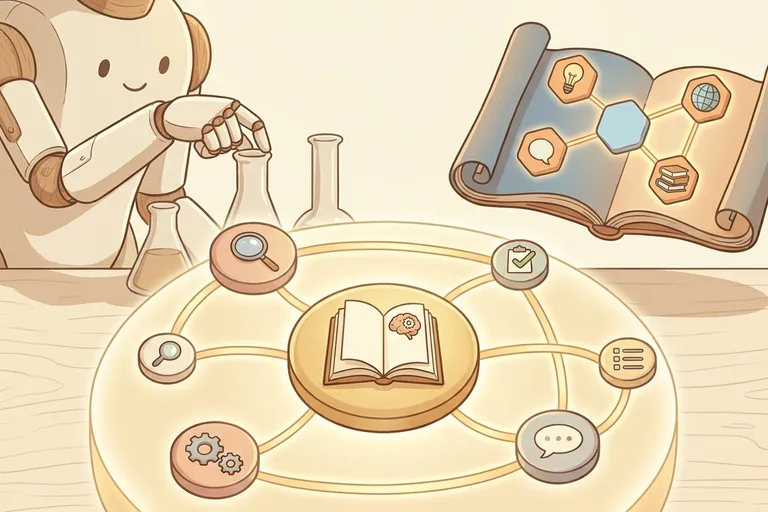
The AI landscape continues its rapid evolution, with significant developments in agent frameworks, learning mechanisms, and hardware integration. Today's news showcases how community contributions are shaping leading AI tools, how agents are becoming more adept at learning from their experiences, and how the industry is working towards more seamless interaction between AI and physical systems.
🛠️ OpenClaw Community Focuses on Task Brain and SkillFortify
The OpenClaw community is actively driving the framework's future development, with significant attention on the 'Task Brain' and the widespread adoption of 'SkillFortify'. Community discussions and open issues through Q1 2026 indicate a strong push for the Task Brain, which unifies various agent components onto a SQLite-backed ledger, drawing an analogy to Kubernetes container scheduling for AI agent tasks (Source: [29]). This enhancement aims to streamline task management and execution within the OpenClaw framework. Furthermore, the 'ClawHavoc' campaign, which exploited a vulnerability through malicious skills, led to a complete overhaul of OpenClaw’s skill verification pipeline. The framework now implements 'SkillFortify', a formal verification system that shifts the trust model from community consensus to verifiable mathematical proof, making it a mandatory component for all production deployments (Source: [30]). OpenClaw maintains its commitment to open-source principles under the BSD-3 license, fostering broad adoption and contributions (Source: [30]).
🧠 Google Introduces WikiSkill for Persistent AI Agent Memory
Google Research has unveiled WikiSkill, an innovative framework designed to provide AI agents with a persistent knowledge base, enabling them to learn from past experiences. Instead of discarding learned information after each task, agents using WikiSkill document both their failures and successes in a wiki-like structure. This accumulated knowledge is then utilized to improve future performance (Source: [25]). The research indicates that larger models benefit significantly from WikiSkill, and notably, smaller models equipped with WikiSkill can achieve performance levels comparable to larger models that lack this persistent memory feature (Source: [25]). This development marks a step forward in creating more adaptive and continuously improving AI agents.
🤖 Anthropic Unveils Model Hardware Standard for Physical Device Integration
Anthropic is extending its efforts from software protocols to physical hardware with the introduction of its Model Hardware Standard (MHS). This new standard aims to provide AI agents with a unified interface for interacting with various physical devices, such as robotic arms and laboratory instruments (Source: [28]). Early tests of MHS have demonstrated a significant reduction in integration time, decreasing from weeks to just hours. This streamlined integration process could accelerate the deployment of AI in robotics and automated systems. However, initial observations indicate that while integration is faster, human oversight remains crucial as Claude sometimes struggles to fully grasp physical cause and effect (Source: [28]).
🏗️ Caterpillar Leverages Mining Automation Expertise for AI Deployment
Caterpillar is applying its extensive experience in automating machinery at remote mining sites to the broader field of AI deployment. Having spent decades perfecting autonomous operations in challenging environments, the company is now bringing this deep understanding of real-world machine intelligence and operational efficiency to the implementation of AI solutions (Source: [7]). This move highlights a trend where established industrial leaders are leveraging their domain-specific knowledge to contribute to and benefit from the expanding capabilities of AI.
What this means
These developments collectively point to a maturing AI ecosystem focused on robustness, continuous learning, and practical application. The OpenClaw community's drive for verifiable skill integrity and enhanced task management underscores the growing need for reliable and scalable agent frameworks. Google's WikiSkill addresses a fundamental challenge in AI by enabling agents to build and leverage long-term memory, leading to more intelligent and efficient systems. Anthropic's push for a unified hardware standard, alongside Caterpillar's strategic application of its automation expertise, signals a strong industry trend towards bridging the gap between AI software and the physical world, making AI agents more capable and integrated into diverse operational environments.
The trajectory of AI development is clearly moving towards more intelligent, reliable, and physically integrated autonomous systems.
Sources
- •OpenClaw 2026: Latest Version, Changelog & Updates
- •OpenClaw: The AI Agent Framework Explained (Refreshed) — clawbot.blog
- •Google's WikiSkill gives AI agents a persistent memory of past mistakes to sharpen future performance (The Decoder)
- •Anthropic wants to do for physical hardware what its Model Context Protocol did for software (The Decoder)
- •Caterpillar is bringing to AI deployment what it learned from automating mining (TechCrunch AI)