OpenAI's GPT-6 Astra Accelerates Research, Google Unveils WeatherNext 3 and Lyria 3.5
Today's AI news highlights OpenAI's internal productivity gains with GPT-6 Astra, Google's advancements in weather forecasting and AI music generation, and Meta's new real-time audio model.
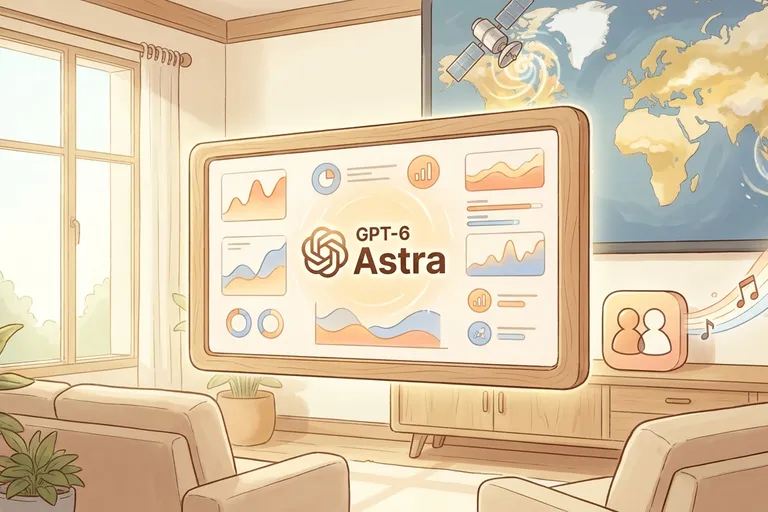
The AI landscape continues its rapid evolution, with major players announcing significant strides in model capabilities and application. From internal productivity boosts to enhanced weather predictions and creative tools, today's updates underscore the accelerating pace of innovation across the industry.
🚀 OpenAI's GPT-6 Astra Boosts Internal Productivity by Six Months
OpenAI's latest model, GPT-6 Astra, has proven to be a significant accelerator for the company's internal research and development. An OpenAI developer, Thibault Sottiaux, stated that Astra is the company's "biggest competitive advantage" and its internal use has boosted productivity to such an extent that some project timelines have been pulled forward by six months (The Decoder [11]). This internal adoption highlights the practical impact of advanced AI models on development cycles and innovation velocity within leading AI organizations (OpenAI Blog [18]). The company has also shared prompting tips for GPT-6 Astra, guiding developers on how to leverage the model for greater initiative and to avoid common AI "slop" phrases (The Decoder [26]).
☁️ Google Launches WeatherNext 3 for Enhanced Global Weather Forecasting
Google Research and DeepMind have released WeatherNext 3, a new weather model that marks a significant departure from traditional physics-based simulations. This model learns directly from real-time satellite data, offering hourly forecasts with up to five-kilometer resolution, a five-fold improvement in detail compared to its predecessor (The Decoder [10]). Google anticipates that regions in Africa, Latin America, and the Asia-Pacific, which have historically lacked accurate forecasts, will experience the most substantial benefits from this advancement. This development represents a leap forward in leveraging AI for critical environmental predictions.
🎶 Google Integrates Lyria 3.5 for AI Music Generation into Gemini App
Google has further expanded its AI capabilities by integrating the Lyria 3.5 music model directly into the Gemini app and making it available via API. This new model promises more expressive vocals and richer arrangements in AI-generated music (The Decoder [12]). Google emphasizes that Lyria 3.5 was trained exclusively on licensed content, addressing concerns around data sourcing. The model is also accessible through Flow Music, AI Studio, and Google Vids, broadening its reach for creative applications.
🗣️ Meta Introduces Muse Voice Transcribe for Real-Time Audio Processing
Meta's Superintelligence Labs have unveiled Muse Voice Transcribe, a real-time transcription model designed to process speech in 80-millisecond chunks. This advanced model can differentiate between speakers and accurately detect sentence boundaries (The Decoder [13]). According to Artificial Analysis, Muse Voice Transcribe offers the most accurate streaming transcription at the lowest market price. Meta views this model as a foundational component for future personal AI agents that can continuously listen and interact through devices like camera glasses, paving the way for more seamless and responsive AI assistance.
What this means
Today's news showcases a clear trend towards more integrated and impactful AI applications. OpenAI's internal success with GPT-6 Astra demonstrates the tangible benefits of advanced models in accelerating development. Meanwhile, Google's WeatherNext 3 and Lyria 3.5 highlight the expansion of AI into critical forecasting and creative domains, respectively. Meta's Muse Voice Transcribe points to the future of ubiquitous, real-time AI assistance, suggesting a future where AI is deeply embedded in our daily interactions and tools.
The direction of AI development continues to emphasize practical utility, efficiency gains, and the creation of new capabilities across diverse sectors.
Sources
- •Supporting independent journalism in Ukraine (OpenAI Blog)
- •Google's WeatherNext 3 ditches physics simulations and learns weather directly from live satellite data (The Decoder)
- •OpenAI developer claims Astra boosted productivity so much it pulled some plans forward by six months (The Decoder)
- •Google brings AI music generation directly into the Gemini app with its new Lyria 3.5 model (The Decoder)
- •Meta's new real-time audio model is the foundation for AI assistants that never stop listening (The Decoder)
- •Research acceleration: The view inside OpenAI (OpenAI Blog)
- •OpenAI shares prompting tips for GPT-6 Astra including a blocklist of slop words (The Decoder)