OpenAI's Codex Unveils 'Record & Replay,' Revolutionizing Workflow Automation
Today's AI news highlights OpenAI's new workflow automation, a Nobel laureate's move to Anthropic, and innovative AI agent applications.
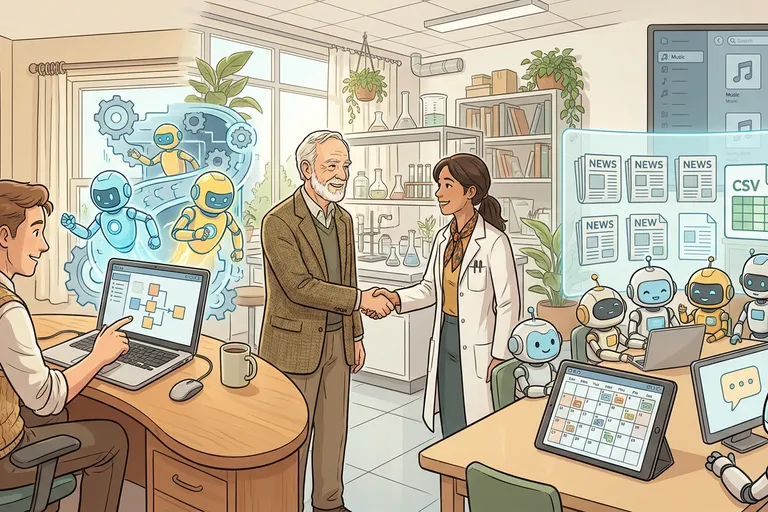
The AI landscape continues its rapid evolution, with significant advancements in automation, talent movement, and practical applications of AI agents. Today's news showcases how these developments are shaping the future of work and data interaction, pushing the boundaries of what AI can achieve in real-world scenarios.
🤖 OpenAI's Codex Introduces 'Record & Replay' for Seamless Automation
OpenAI has launched a groundbreaking "Record & Replay" feature for its Codex app on macOS, enabling users to automate complex workflows with unprecedented ease. This new capability allows users to demonstrate a task once, after which Codex converts it into a reusable "skill" that can be repeated indefinitely, as reported by The Decoder [8]. This innovation streamlines repetitive processes, offering a powerful tool for enhancing productivity by transforming observed actions into automated routines. The feature is currently available outside the EU, UK, and Switzerland, marking a significant step towards more intuitive and accessible AI-driven automation.
🔬 Nobel Laureate John Jumper Joins Anthropic from DeepMind
In a notable shift within the AI research community, Nobel laureate John Jumper has departed Google DeepMind to join Anthropic, as reported by TechCrunch AI [6] and The Decoder [18]. Jumper, known for his pivotal work in protein folding with AlphaFold, brings his extensive expertise to Anthropic after nearly nine years at DeepMind. This move signifies a continued dynamic in top-tier AI talent, with leading researchers gravitating towards new opportunities to advance the field. His transition underscores the competitive and evolving nature of AI research and development, as companies vie for the brightest minds to drive innovation.
📰 Data2Story Leverages Seven AI Agents to Generate Verified News Articles
A new system called Data2Story, developed by researchers from Oxford and Stanford, is transforming how news articles are generated by using seven AI agents to convert CSV files into verified, interactive news stories [11]. This innovative approach allows a "Data Journalist Agent" to produce articles complete with graphics, web research, and verifiable source links for 93 percent of all statements. A reader study indicated that 74 percent of participants preferred the AI-generated output over human-written originals, demonstrating the potential for AI agents to enhance journalistic efficiency and accuracy. This development highlights the growing sophistication of multi-agent AI systems in complex tasks.
🗓️ ChatGPT Enhances Personal Assistant Capabilities with New Scheduled Task Controls
OpenAI is upgrading ChatGPT's scheduling features, further solidifying its role as a personal AI assistant. A new "Scheduled" page in the sidebar now centralizes all active tasks, allowing users to easily view, pause, edit, or delete them, according to The Decoder [12]. This enhancement includes research tasks that search the web and connected applications, providing alerts only when relevant changes occur. The previous "Pulse" feature is being retired, indicating a move towards a more integrated and user-friendly task management system within ChatGPT, making it an even more powerful tool for daily organization and information gathering.
🎶 The Atlantic Creates Searchable Database of AI Training Music
The Atlantic has compiled a publicly searchable database of music used to train AI models, a significant resource for understanding AI's impact on creative industries. Reporter Alex Reisner uncovered four datasets, two of which are enormous, containing 12 million and 9 million tracks respectively, with two smaller sets still holding over 100,000 songs each, as reported by The Verge AI [3]. These datasets have been downloaded thousands of times, and companies like Google and Stability have confirmed their use in research papers. This initiative provides transparency into the data sources fueling AI development in music, offering insights into the scale and scope of training data utilized by leading AI entities.
What this means: The convergence of advanced automation, strategic talent acquisition, and sophisticated multi-agent systems is accelerating AI's integration into daily workflows and creative processes. These developments point to a future where AI not only assists but actively drives productivity and innovation across various sectors. The increasing transparency in AI training data also signals a growing awareness of the need for accountability and understanding in AI's development.
The trajectory of AI innovation continues to focus on practical applications that enhance efficiency and expand creative possibilities.
Sources
- •OpenAI's Codex can now watch you work once and repeat the task forever (The Decoder)
- •Nobel laureate John Jumper is leaving DeepMind for rival Anthropic (TechCrunch AI)
- •Google Deepmind loses another top AI researcher as Nobel laureate John Jumper leaves for Anthropic (The Decoder)
- •Data2Story turns a CSV file into a verified interactive news article using seven AI agents (The Decoder)
- •ChatGPT keeps creeping toward becoming your AI personal assistant with new scheduled task controls (The Decoder)
- •The Atlantic created a searchable database of the music used to train AI (The Verge AI)