Google DeepMind's WikiSkill and Co-Scientist Advance AI Agent Capabilities
Today's AI news highlights significant advancements in AI agent learning and scientific research, alongside Anthropic's new hardware standard and LAION's massive video dataset release.
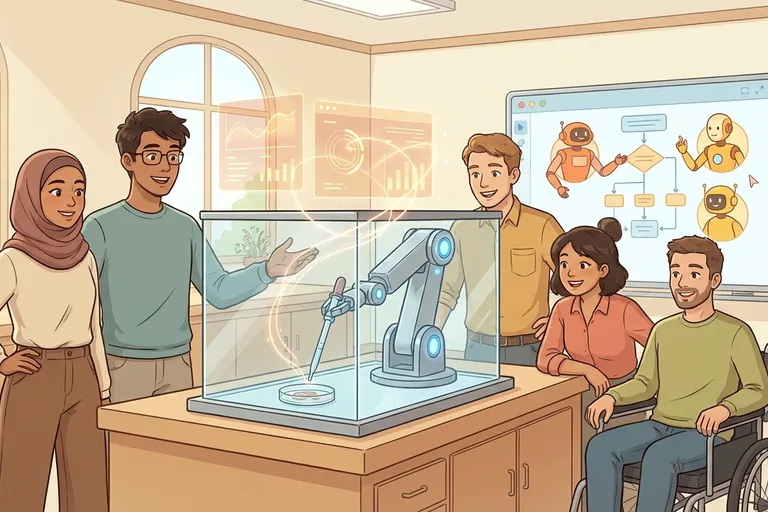
The AI landscape continues its rapid evolution, with today's news showcasing breakthroughs in how AI agents learn, interact with the physical world, and contribute to scientific discovery. From Google's innovative approaches to persistent memory and scientific experimentation to Anthropic's efforts in hardware integration, the focus is increasingly on building more capable and autonomous AI systems.
🧠 Google Introduces WikiSkill for Persistent AI Agent Memory
Google Research has unveiled WikiSkill, a novel framework designed to equip AI agents with a persistent knowledge base, allowing them to learn from past experiences. Instead of discarding information after each task, agents using WikiSkill document both successes and failures in a wiki-like structure, leveraging this accumulated knowledge to enhance future performance. This approach has shown that even smaller models, when augmented with WikiSkill, can achieve performance levels comparable to larger models without it, as reported by The Decoder [11]. This development marks a significant step towards more robust and continuously improving AI agents.
🔬 Google DeepMind's Co-Scientist Now Plans and Executes Experiments
Google DeepMind has expanded the capabilities of its Co-Scientist, transforming it from a hypothesis generator into a comprehensive research system integrated directly into laboratory environments. This Gemini-based multi-agent system can now plan experiments, operate lab equipment, and even draft scientific papers. Across diverse fields, including materials synthesis and the autonomous development of medical AI architectures, Co-Scientist has delivered experimentally validated results, according to The Decoder [18]. This represents a major leap in AI's role within scientific research, potentially accelerating discovery processes.
⚙️ Anthropic Unveils Model Hardware Standard for Unified Device Control
Anthropic has introduced its Model Hardware Standard (MHS), aiming to provide AI agents with a unified interface for controlling physical devices such as robotic arms and laboratory instruments. This initiative seeks to replicate the success of its Model Context Protocol for software in the realm of physical hardware. Early tests have demonstrated a dramatic reduction in integration time, from weeks to mere hours, as detailed by The Decoder [14]. While human oversight remains crucial due to occasional difficulties in grasping physical cause and effect, MHS promises to streamline the deployment of AI in real-world physical applications.
🎥 LAION Releases Massive Open Video Dataset for AI Research
LAION has made a significant contribution to the AI research community by releasing its Big Video Dataset (BVD), one of the largest open video datasets available. Comprising 80 million videos, 10 million hours of runtime, and 55 million auto-described clips, BVD offers an unprecedented resource for training and evaluating AI models. Models trained on BVD have already surpassed previous benchmarks, outperforming InternVid by up to 2.1 percentage points, as reported by The Decoder [13]. This massive dataset is expected to fuel advancements in video understanding and generation research.
📈 Anthropic Researcher Demos Self-Improving AI
An Anthropic researcher has provided a glimpse into the future of self-improving AI, demonstrating automated systems capable of enhancing their performance on specific misaligned behaviors. Given 10 benchmarks, these systems successfully improved on every single one without compromising overall performance, according to TechCrunch AI [17]. This research highlights the potential for AI systems to autonomously refine their own behaviors and align more closely with intended objectives, paving the way for more reliable and adaptable AI.
What this means: Today's news paints a picture of AI systems becoming increasingly sophisticated in their ability to learn, interact with the physical world, and contribute to complex domains like scientific research. The development of persistent memory, unified hardware interfaces, and self-improvement mechanisms are all converging to create more autonomous and capable AI agents. The release of large, open datasets further accelerates this progress by providing the necessary fuel for training advanced models.
The trajectory of AI development is clearly moving towards more integrated, self-optimizing, and domain-specific intelligent systems.
Sources
- •Google's WikiSkill gives AI agents a persistent memory of past mistakes to sharpen future performance (The Decoder)
- •Google Deepmind's AI Co-Scientist now plans experiments, runs lab equipment, and writes scientific papers (The Decoder)
- •Anthropic wants to do for physical hardware what its Model Context Protocol did for software (The Decoder)
- •LAION drops massive open video dataset with 10 million hours of footage for AI research (The Decoder)
- •An Anthropic researcher just gave us a peek at self-improving AI (TechCrunch AI)